Core engine
From first structure to interpretable MD report
Learn molecular dynamics by walking through PyMACS.
A full educational website for people who are new to MD, curious about force fields, and ready to understand what every PyMACS script does from setup through analysis.
Structure
CHARMM36
GROMACS
Analysis
New to GROMACS?
Start from a clean simulation engine installation.
PyMACS includes a companion installation path for supported Linux and WSL2 systems, allowing one system GROMACS installation to work across your PyMACS environments.
Linux
WSL2
GROMACS 2026.3
NVIDIA CUDA
Conda-independent
What PyMACS connects
One pipeline, many concepts.
Primary force field
CHARMM36 / LJ-PME
The workflow ships CHARMM36-family files and highlights the LJ-PME variant for compatible runs.Small molecules
CGenFF
Ligands and cofactors can use CGenFF-style MOL2 and STR files converted into GROMACS topology files.Main outputs
Trajectories, CSVs, figures, PDFs
PyMACS turns raw MD files into stability plots, contact maps, networks, and figurebooks.Learning path
Designed for someone starting from zero.
1
2
3
4
5
Learn what MD is
Start with atoms, forces, time steps, temperature, pressure, and why a trajectory is more informative than one static structure.
Understand force fields
Compare CHARMM, AMBER, OPLS, GROMOS, Martini, and the role of CGenFF for drug-like molecules.
Follow the PyMACS scripts
Walk through setup, parameterization, equilibration, production MD, trajectory analysis, networks, and report generation.
Run the first example
Use the curated Example 1 path to see exactly what files are copied, which environments are activated, and which commands are run.
Interpret the outputs
Learn what RMSD, RMSF, radius of gyration, contact maps, interaction types, and figurebooks mean in practice.
PyMACS at a glance
The scripts form a readable scientific story.
PyMACS is not just a command runner. Each numbered script corresponds to a stage in the molecular dynamics argument: prepare the system, relax it, run it, analyze it, then communicate the result.
Step 1
System Preparation
1_AutomateGromacs.py
Step 2
Equilibration and Production MD
2_AutomateGromacs.py
Step 3A
Trajectory Analysis
3A_AutomateGromacs.py
Step 3B
Interaction Network Rendering
3B_NETWORX.py
Specialized
PROTAC and Ternary Complex Analysis
3_PROTAC_Analysis.py
Step 4
Figurebook Generation
4PDF4MD.py
Representative outputs
Raw trajectories become interpretable figures.
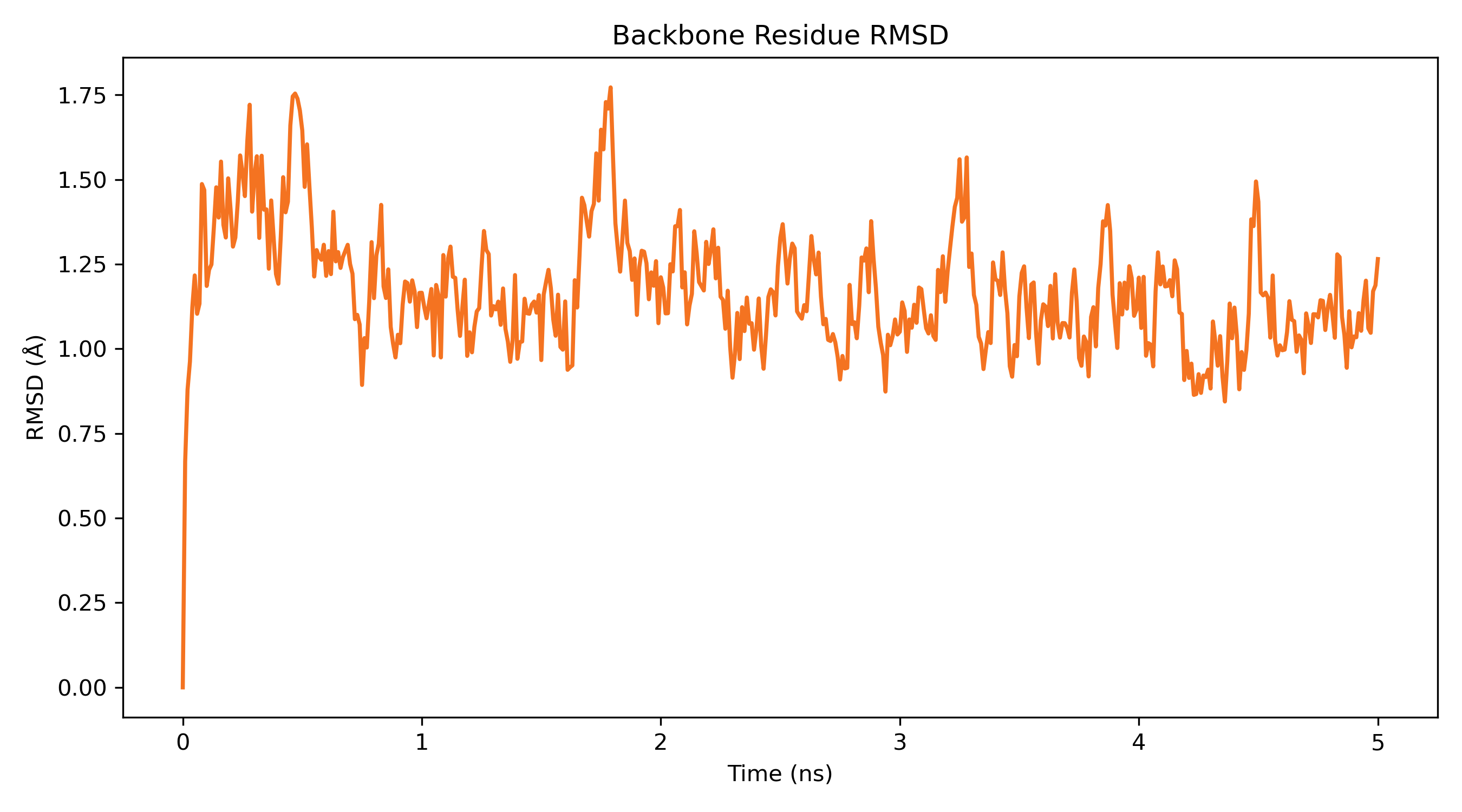
Protein RMSD
Tracks global backbone stability after alignment. A plateau usually suggests the protein has settled into a stable conformational regime.
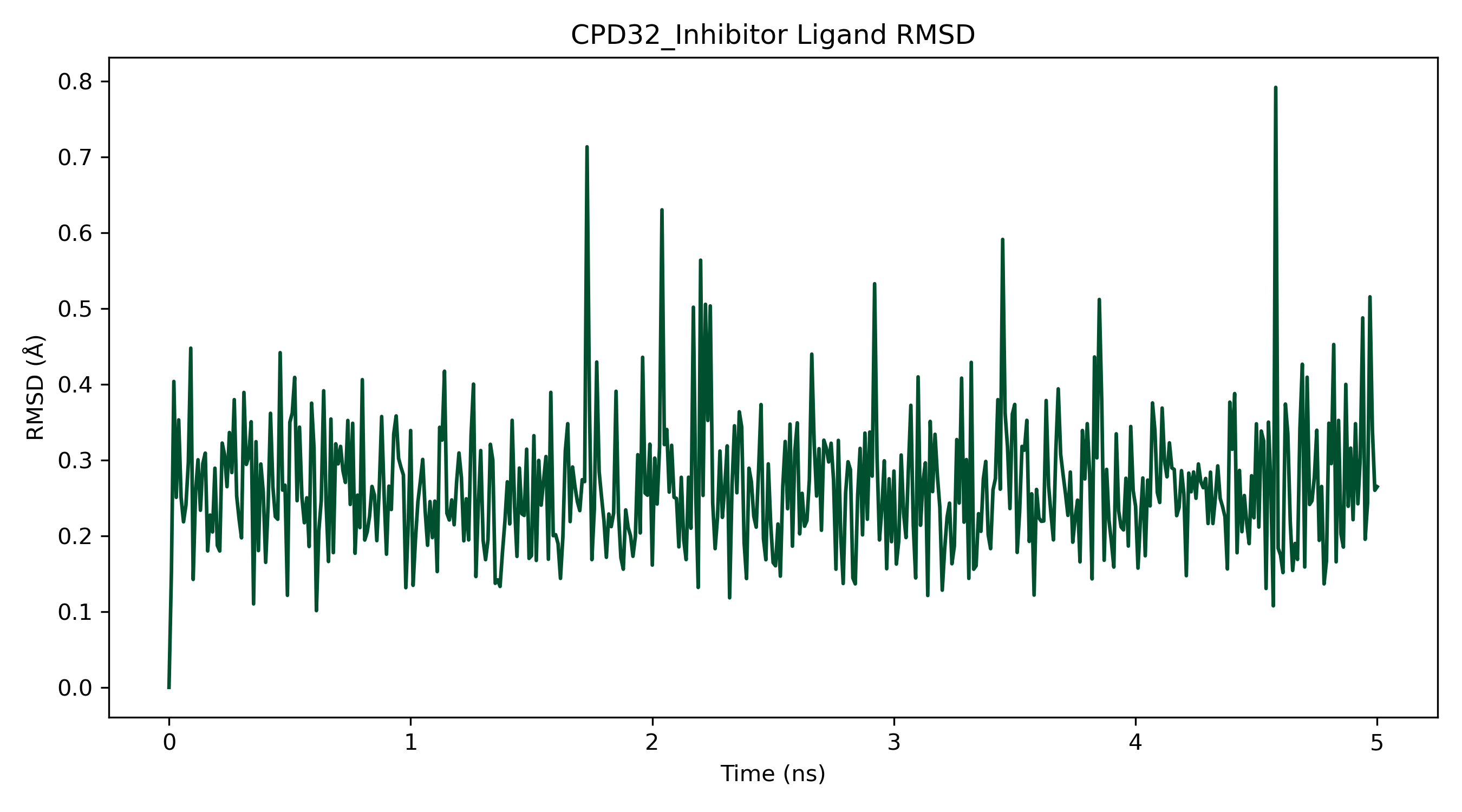
Ligand RMSD
Shows whether the ligand preserves its starting binding pose, samples nearby sub-poses, or leaves the pocket.
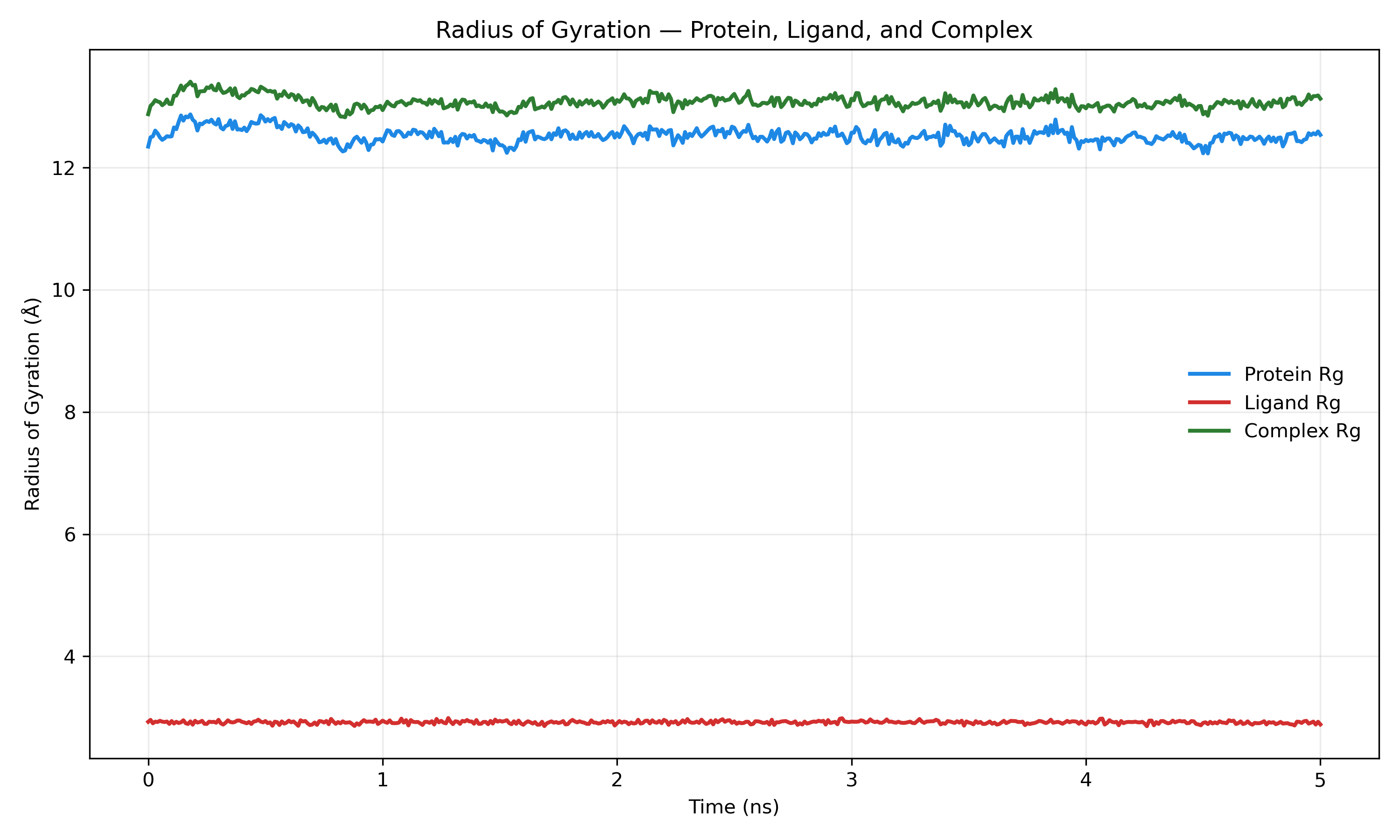
Radius of Gyration
Measures compactness for the protein, ligand, and full complex as the trajectory evolves.